
Insert a standard part
Screws, nuts, washers, ball bearings and O-rings come from the built-in library of ISO and ANSI standards, in their standard sizes and lengths. You do not model them: choose the standard, the size and the length, and they go into the assembly as components.
Access: assembly editor > Standard.
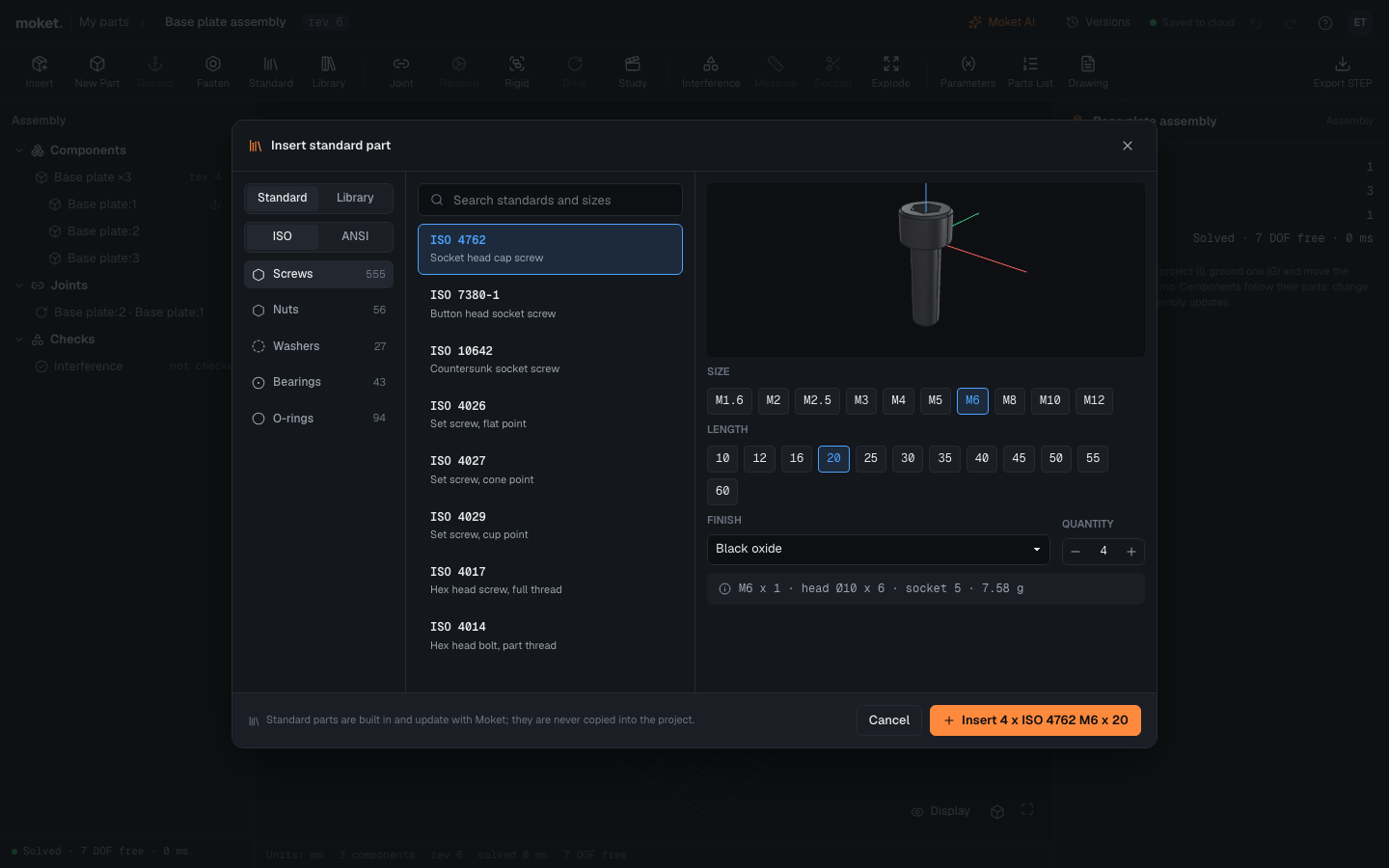
Insert a standard part
- Click Standard.
- Choose ISO or ANSI, then a category: Screws, Nuts, Washers, Bearings or O-rings. Or type in the search box, for example
socketor608. - Click a standard. The preview shows it in the size you choose.
- Click a Size and, for screws, a Length.
- Choose a Finish if the part's own does not suit, and the Quantity.
- Click Insert.
The components land next to the assembly, free to move. Connect them with joints like any component. Their names say the standard and the size, for example ISO 4762 M6 x 20:1, and the parts list counts them by size: ISO 4762 M6 x 20 ×4.
The library
| Category | ISO | ANSI |
|---|---|---|
| Screws | ISO 4762 socket head cap, ISO 7380-1 button head, ISO 10642 countersunk, ISO 4026, 4027 and 4029 set screws (flat, cone and cup point), ISO 4017 and ISO 4014 hex head | ASME B18.3 socket head cap screws (#0-80 to 1/2-13), ASME B18.2.1 hex cap screws |
| Nuts | ISO 4032 hex nuts and ISO 4035 thin hex nuts, M1.6 to M36; DIN 103 trapezoidal hex nuts Tr10x2 to Tr60x9; the T8 flanged lead screw nut of 3D printers, Tr8x2 and Tr8x8(P2), in brass | ASME B18.2.2 hex nuts |
| Washers | ISO 7089 plain (M1.6 to M36), ISO 7090 chamfered (M5 to M36) | ASME B18.21.1 plain washers, type A narrow |
| Bearings | ISO 15 deep groove ball bearings, shielded: 623 to 629, 608, 688, 698, 6800, 6900, 6000 to 6004, 6200 to 6204; angular contact ball bearings, 40°: 7200B to 7204B, 7300B to 7304B; ISO 355 tapered roller bearings: 30202 to 30204, 30302 to 30304, 32004X, 32203, 32204, 32303, 32304 | Inch ball bearings R2, R3, R4, R6 and R8 |
| O-rings | ISO 3601-1 class A (the AS568 sizes) in cross-sections 1.78, 2.62, 3.53 and 5.33 mm |
Metric fasteners come in M1.6 to M12 where the standard has them, with the standard's lengths; inch ones in #0 to 1/2 inch.
Options
| Option | What it does |
|---|---|
| Size | The thread size, bearing number or O-ring size. |
| Length | A screw's nominal length: under the head, or overall for countersunk and set screws. |
| Finish | Black oxide for socket screws, zinc plated for hex screws, nuts and washers, polished steel for bearings, rubber for O-rings; any other finish. |
| Quantity | How many components to insert, up to 100. |
The line under the options sums the part up: the thread and its pitch, the head or the hexagon, and the mass of one in its material.
To put screws into holes with the right size and length at once, use Fasten.
Parts you modeled yourself, such as rails, motors and couplings, go into your own library: see Keep parts in your library. The Library tab at the top of the dialog inserts them.
Where a standard part's origin is
Joints that use a component's origin place standard parts the way they are mounted:
- Socket head, button head and hex head screws: on the axis under the head, the head along +Z.
- Countersunk and set screws: on the axis at the top face, the screw along -Z.
- Nuts and washers: on the axis at the bottom face. The T8 flanged nut: at the bottom of its flange, the body along +Z.
- Ball bearings and O-rings: at the center, the axis along Z. An angular contact bearing's back face, the one that takes the thrust, is toward -Z.
- Tapered roller bearings: on the axis at the back face of the inner ring (the cone), the outer ring (the cup) toward +Z.
Tips
- Standard parts are built into Moket and are not copied into your project. You cannot edit them, and they do not appear among the project's parts.
- To change a component to another size, select it and choose a row under Configuration in its properties: every size and length of the standard is a configuration.
- Export STEP writes them like your own parts, with their names, for example
ISO 4762in the size the component uses.
Limitations
- Threads are cosmetic: a screw is a plain cylinder of its nominal diameter, and a nut's hole has that diameter too. Trapezoidal nuts are drilled to their minor diameter, like a tapped hole.
- The shapes are simplified: heads and nuts have no chamfers, sockets have flat bottoms, bearings are one solid with the shields set back, and a tapered roller bearing is its cone and cup as one solid with the rollers between them filled in.